Heat Transfer - Ceballos Romero Enrique
Heat Transfer - Ceballos Romero Enrique
10 Glossary - WEEK 4 terms
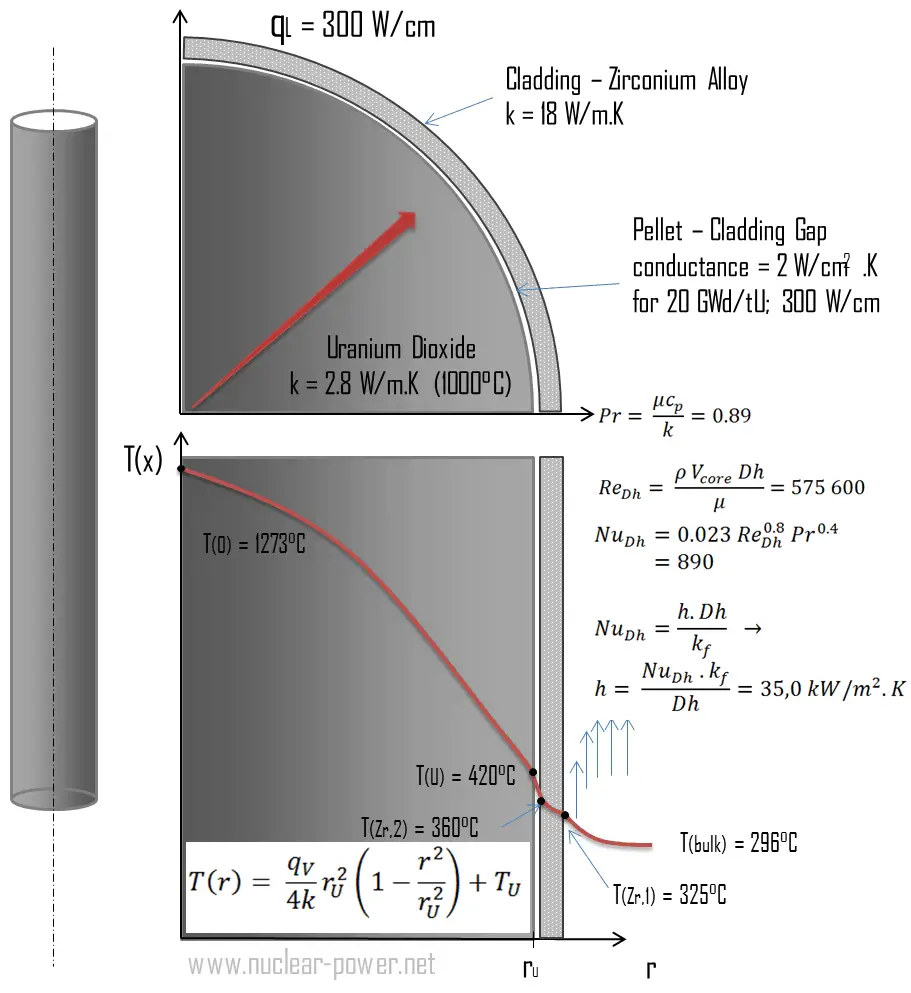
- Convection heat transfer coefficient
- noun
- The convective heat transfer coefficient, can be defined as: The rate of heat transfer between a solid surface and a fluid per unit surface area per unit temperature difference. The convective heat transfer coefficient is dependent upon the physical properties of the fluid and the physical situation.
- Example: Typically, the convective heat transfer coefficient for laminar flow is relatively low compared to the convective heat transfer coefficient for turbulent flow. This is due to turbulent flow having a thinner stagnant fluid film layer on the heat transfer surface.
- es: Coeficiente de transferencia de calor por convección
- Critical Reynold’s number
- noun
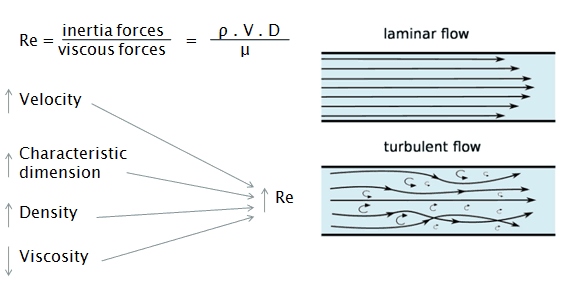
- The critical Reynolds number is associated with the laminar-turbulent transition, in which a laminar flow becomes turbulent. This is an extraordinarily complicated process, which at present is not fully understood.
- Example: The critical Reynolds number for a laminar condition to prevail depends somewhat on the surface geometry itself, but it is generally safe to assume that it will apply for Re < 2200, provided that there is little inlet turbulence. Fully-developed flow is considered first, then developing flow.
- es: Número crítico de Reynolds
- Friction Coefficient
- noun
- Friction is the force resisting the relative motion of solid surfaces, fluid layers, and material elements sliding against each other. There are several types of friction:
Fluid friction describes the friction between layers of a viscous fluid that are moving relative to each other.
Lubricated friction is a case of fluid friction where a lubricant fluid separates two solid surfaces.
Internal friction is the force resisting motion between the elements making up a solid material while it undergoes deformation.
- Example: Ice on steel has a low coefficient of friction – the two materials slide past each other easily – while rubber on pavement has a high coefficient of friction – the materials do not slide past each ot
- es: Coeficiente de fricción

- Kinematic viscosity
- noun
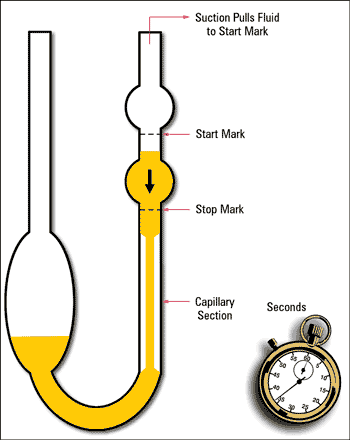
- Kinematic viscosity is a measure of a fluid's internal resistance to flow under gravitational forces. It is determined by measuring the time in seconds, required for a fixed volume of fluid to flow a known distance by gravity through a capillary within a calibrated viscometer at a closely controlled temperature.
- Example: Viscous motor oil slowly slides down a tube, but will still be less dense than water when floating on top of it.
- es: Viscosidad cinemática
- Laminar flow
- noun
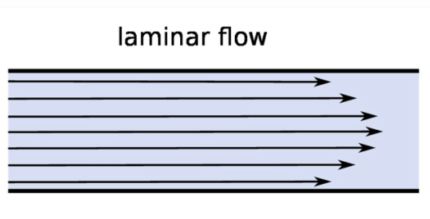
- Laminar flow, type of fluid (gas or liquid) flow in which the fluid travels smoothly or in regular paths. In laminar flow, sometimes called streamline flow, the velocity, pressure, and other flow properties at each point in the fluid remain constant. Laminar flow over a horizontal surface may be thought of as consisting of thin layers, or laminae, all parallel to each other. The fluid in contact with the horizontal surface is stationary, but all the other layers slide over each other.
- Example: The flow of air over an aircraft wing.
- es: Flujo laminar
- Nusselt number
- noun
- The Nusselt number is a dimensionless number closely related to Péclet number and both numbers are used to describe the ratio of the thermal energy convected to the fluid to the thermal energy conducted within the fluid. Nusselt number is equal to the dimensionless temperature gradient at the surface, and it provides a measure of the convection heat transfer occurring at the surface.
- Example: A Nusselt number of value one represents heat transfer by pure conduction. A value between one and 10 is characteristic of slug flow or laminar flow. A larger Nusselt number corresponds to more active convection, with turbulent flow typically in the 100–1000 range.
- es: Número de Nusselt

- Prandtl number
- noun
- The Prandtl number (Pr) or Prandtl group is a dimensionless number, named after the German physicist Ludwig Prandtl, defined as the ratio of momentum diffusivity to thermal diffusivity.
- Example: Fluids with small Prandtl numbers are free-flowing liquids with high thermal conductivity and are therefore a good choice for heat conducting liquids.
- es: Número de prandtl

- Reynold number
- noun
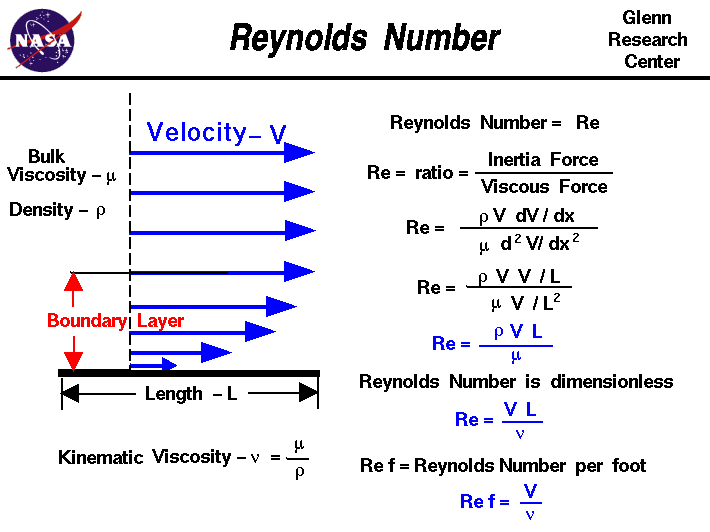
- The Reynolds number (Re) helps predict flow patterns in different fluid flow situations. At low Reynolds numbers, flows tend to be dominated by laminar (sheet-like) flow, while at high Reynolds numbers flows tend to be turbulent. The turbulence results from differences in the fluid's speed and direction, which may sometimes intersect or even move counter to the overall direction of the flow (eddy currents). These eddy currents begin to churn the flow, using up energy in the process, which for liquids increases the chances of cavitation. Reynolds numbers are an important dimensionless quantity in fluid mechanics.
- Example: a dimensionless parameter used to determine the nature of fluid flow along surfaces and around objects, as in a wind tunnel
- es: Número de Reynold
- Shear stress
- noun
- Shear stress, is the component of stress coplanar with a material cross section. It arises from the shear force, the component of force vector parallel to the material cross section. Normal stress, on the other hand, arises from the force vector component perpendicular to the material cross section on which it acts.
- Example: While walking or running while our feet push ground back to move forward.
- es: Esfuerzo cortante

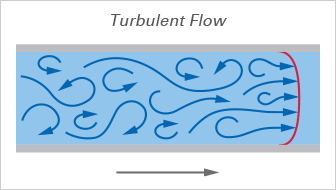
- Turbulent flow
- noun
- In fluid dynamics, turbulence or turbulent flow is fluid motion characterized by chaotic changes in pressure and flow velocity.
- Example: Turbulence is commonly observed in everyday phenomena such as surf, fast flowing rivers, billowing storm clouds, or smoke from a chimney, and most fluid flows occurring in nature or created in engineering applications are turbulent.
- es: Flujo turbulento